
When you're standing at the jewelry counter—or scrolling through our collection at 2 AM, coffee in hand—one question inevitably stops you in your tracks: Which gold karat is actually right for me?
At Oveela Jewelry, we believe the metal you choose is just as personal as the design itself. It's not merely about budget or trends. It's about how you live, what you love, and how you want your ring to age alongside your story.
Let's dismantle the confusion around 10K, 14K, and 18K gold so you can make a choice that feels as right ten years from now as it does today.
Gold Karat Guide: What You Really Need to Know (Complete Guide)
- What "Karat" Actually Means
- The Durability Reality Check
- Color Chemistry: Why Not All Gold Looks the Same
- Lifestyle Matching: Who Should Choose What
- The Skin Tone Factor
- The Price Reality: What You're Actually Paying For
- The Allergy Question: Don't Ignore Your Body
- Caring for Your Gold: Karat-Specific Tips
- The Oveela Jewelry Philosophy
- Quick Decision Matrix
- Final Thoughts: Trust Your Instincts (But Verify With Facts)
- Frequently Asked Questions
What "Karat" Actually Means
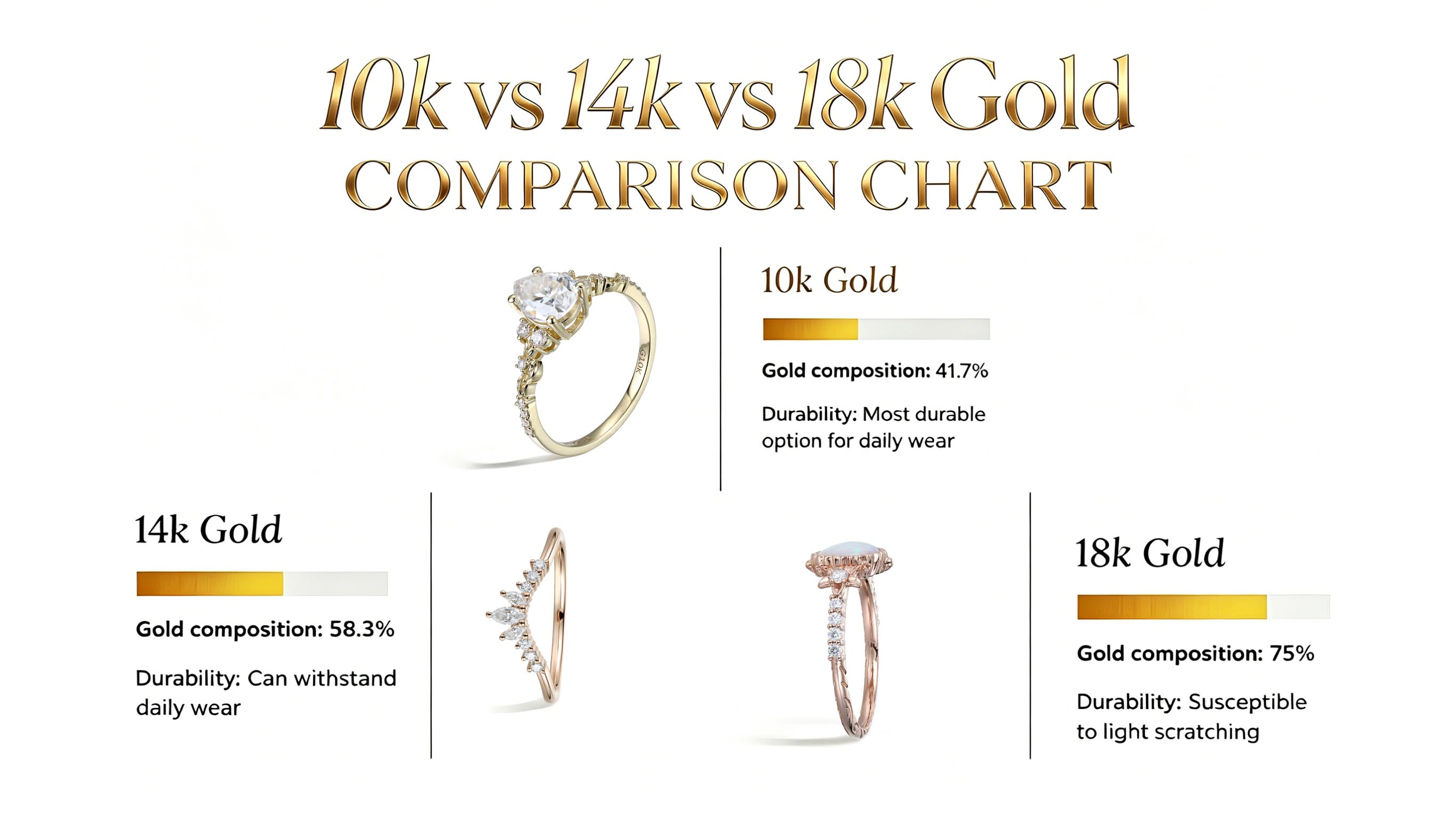
Before we compare, let's ground ourselves in what these numbers represent. Karat (K) measures purity out of 24 parts. Pure gold is 24K—beautiful, impossibly soft, and frankly, impractical for jewelry you'll actually wear.
- 10K Gold:7% pure gold, 58.3% alloy metals
- 14K Gold:3% pure gold, 41.7% alloy metals
- 18K Gold:75% pure gold, 25% alloy metals
Those alloy metals—copper, silver, zinc, nickel, palladium—aren't fillers. They're the architects of durability, the alchemists of color, and sometimes, the culprits behind skin irritation. Understanding this chemistry is the first step to choosing wisely.
The Durability Reality Check
Here's where most guides get it wrong: they treat durability as a simple hierarchy. It isn't.
10K Gold: The Workhorse
With the highest alloy content, 10K gold is objectively the most scratch-resistant and deformation-resistant option. If you're a rock climber, a mechanic, a parent who never takes their ring off while washing dishes, 10K will take a beating and keep its structural integrity.
The trade-off? That structural strength comes from sacrificing gold's natural warmth. 10K yellow gold can look slightly pale—almost brassy—compared to its higher-karat cousins. And because it contains more nickel and copper, it's the most likely to trigger metal allergies.
14K Gold: The Sweet Spot (And Our Signature Choice)
At oveela jewelry, we craft the majority of our rings in 14K gold because it occupies that rare intersection where practicality meets poetry. It's durable enough for daily wear—resisting scratches better than 18K—while retaining enough pure gold to glow with authentic warmth.
Think of 14K as the cashmere sweater of gold: luxurious enough to feel special, tough enough to live in.
18K Gold: The Purist's Dream
There's no denying the seduction of 18K gold. That deep, buttery yellow. The substantial heft. The knowledge that three-quarters of what you're wearing is pure, elemental gold.
But here's the honest truth we tell every client: 18K gold is softer. It will scratch. It will develop a patina of tiny surface marks that tell the story of your days. For some, this living texture is beautiful—evidence of a life well-lived. For others, it's anxiety-inducing.
Color Chemistry: Why Not All Gold Looks the Same
The karat you choose dramatically affects color, especially in yellow and rose gold.
Yellow Gold: The Warmth Spectrum
- 10K Yellow:Pale, slightly greenish undertone. Can look almost like brass next to higher karats.
- 14K Yellow:Rich, classic golden hue. The color most people picture when they imagine gold jewelry.
- 18K Yellow:Deep, saturated, almost orange-yellow. Undeniably luxurious, especially against olive or deeper skin tones.
Our recommendation: If you're choosing a yellow gold solitaire with a colorless diamond (D-F), 14K or 18K provides that warm contrast that makes the stone pop. A 10K setting can make a colorless diamond appear slightly stark or cold by comparison.
Rose Gold: The Copper Factor
Rose gold's pink hue comes from copper. More copper means more pink—which means lower karat rose gold is actually more vividly rosy.
- 10K Rose Gold:Intensely pink, almost copper-heavy. Dramatic and vintage-leaning, but can feel less "gold."
- 14K Rose Gold:Perfectly balanced. That blush-pink warmth that flatters virtually every skin tone without overwhelming.
- 18K Rose Gold:Subtle, sophisticated pink. More gold than rose. Elegant but understated.
The pairing insight: A 14K rose gold halo setting with a morganite center stone? Heavenly—the warm tones amplify each other. But 10K rose gold with a pink sapphire can feel muddy, the metal competing with the gem rather than elevating it.
White Gold: The Rhodium Illusion
Here's something jewelers don't always advertise: white gold isn't naturally white. All white gold starts yellow and is alloyed with palladium or nickel, then rhodium-plated to achieve that platinum-bright finish.
- 10K White Gold:More nickel, harder, but the rhodium plating wears faster due to the higher alloy content underneath.
- 14K White Gold:The industry standard. Good durability, takes rhodium plating beautifully.
- 18K White Gold:More expensive, slightly warmer natural tone, but the higher gold content means less nickel (better for allergies) and the plating tends to wear more evenly.
Critical note: If you have a nickel sensitivity, avoid 10K white gold entirely. Opt for 14K or 18K, or better yet, request nickel-free palladium-white gold.
Lifestyle Matching: Who Should Choose What
Choose 10K Gold If:
- You work with your hands (construction, healthcare, athletics)
- You're buying a "beater" ring for travel or gym wear
- Budget is your primary constraint
- You prefer white gold or don't mind a paler yellow tone
- You have no metal sensitivities
Best pairings: 10K white gold men's wedding bands, stackable midi rings you plan to wear hard, promise rings for younger buyers.
Avoid pairing with: Large solitaire diamonds (the paler metal can make high-color stones look cold), intricate filigree work (harder metal is tougher to repair if damaged), or if you have any history of skin reactions.


Choose 14K Gold If:
- You want one ring to do everything—work, weekends, workouts
- You're investing in an engagement ring or wedding band for daily wear
- You want the best value-per-wear over decades
- You have mild metal sensitivities (generally safe, but not guaranteed)
- You want rich color without the premium of 18K
Best pairings: 14K yellow gold with vintage-inspired settings, 14K rose gold with peach sapphires or champagne diamonds, 14K white gold with classic round brilliant solitaires. This is our most versatile metal.
Avoid pairing with: Nothing, really. 14K is the universal donor of gold karats. The only reason to avoid it is if you're specifically seeking the prestige of higher purity.


Choose 18K Gold If:
- You're buying a milestone piece (anniversary, push present, heirloom)
- You have sensitive skin or known metal allergies
- You prioritize color richness over scratch resistance
- You lead a relatively gentle lifestyle (office work, minimal manual labor)
- You view jewelry as investment as well as adornment
Best pairings: 18K yellow gold with emerald-cut diamonds (the warm metal complements the step-cut's elegance), 18K rose gold with rubies or padparadscha sapphires, 18K white gold with Asscher-cut stones for Art Deco authenticity.
Avoid pairing with: Rings you'll never remove (the scratches will accumulate), very thin band designs (soft metal bends more easily), or if you have toddlers who grab jewelry (speaking from experience).


The Skin Tone Factor
Your undertone affects how gold reads against your skin. This isn't vanity—it's optics.
Cool undertones (pink/blue veins): 14K or 18K white gold is your friend. If you prefer yellow gold, 18K yellow provides enough warmth without clashing. 10K yellow can look sallow against cool skin.
Warm undertones (green/olive veins): You hit the jackpot—every karat works, but 14K and 18K yellow gold will make your skin glow. Rose gold in any karat is especially flattering.
Neutral undertones: Lucky you. 14K anything is your safest bet. You can swing between warm and cool depending on your mood.
The Price Reality: What You're Actually Paying For
Let's talk numbers without the mystery. As of 2026, with gold hovering near historic highs:
- 10K gold:Roughly 30-40% less than 14K. You're paying for durability, not prestige.
- 14K gold:The middle path. About 40-50% more than 10K, but 30-40% less than 18K.
- 18K gold:Premium pricing. The jump from 14K to 18K is more significant than 10K to 14K because you're crossing into "fine jewelry" territory.
But here's the oveela perspective: Price per wear is the metric that matters. A $1,200 14K ring worn daily for 20 years costs $0.16 per day. A $800 10K ring that you replace or resize multiple times? The math shifts. A $2,000 18K ring that sits in a box because you're afraid to scratch it? That's the most expensive option of all.
The Allergy Question: Don't Ignore Your Body
Metal allergies are real, common, and miserable. Nickel is the usual suspect, and 10K gold contains the most of it.
Signs you're reacting: Itching, redness, dry patches, or blistering where the ring sits. Not immediately—sometimes weeks after you start wearing it.
The hierarchy of safety:
- 18K gold:Lowest allergy risk (least nickel/copper)
- 14K gold:Generally safe for most people
- 10K gold:Highest risk—proceed with caution if you have sensitive skin
Pro tip from our bench jewelers: If you love the durability of 10K but have sensitive skin, request nickel-free alloys. We can customize most designs with palladium-based white gold or nickel-free yellow gold alloys.
Caring for Your Gold: Karat-Specific Tips
10K Gold: Clean with mild soap and water. Avoid harsh chemicals—they can affect the alloy metals more aggressively than pure gold. Store separately to prevent scratching other jewelry (ironically, 10K can scratch softer 18K pieces).
14K Gold: The low-maintenance champion. Annual professional cleaning keeps it luminous. Remove before swimming in chlorinated pools—chlorine can weaken gold alloys over time, regardless of karat.
18K Gold: Be gentle. Remove before heavy lifting, gardening, or rock climbing. Store in a soft pouch. Embrace the patina, or have it professionally polished annually if you prefer that mirror finish.
The Oveela Jewelry Philosophy
We don't believe in "better" or "worse" when it comes to gold karats. We believe in right. The right karat is the one that fits your life, your skin, your budget, and your vision. It's the one that lets you forget you're wearing it because it feels like part of you—not because you're anxious about damaging it.
When you browse our collection, you'll notice we offer 10K, 14K, and 18K options across most designs. Not because we can't decide, but because your story is different from your neighbor's. The nurse who needs a ring that survives hand-washing fifty times a shift. The artist who wants that rich 18K glow for gallery openings. The student buying their first promise ring on a ramen budget.
Every karat has its place. Every ring has its wearer. Our job is to help you find each other.
Quick Decision Matrix
|
Your Priority |
Best Choice |
Why |
|
Maximum durability |
10K |
Highest alloy content, most scratch-resistant |
|
Best all-rounder |
14K |
Optimal balance of durability, color, value |
|
Richest color |
18K |
75% pure gold, deepest hue |
|
Sensitive skin |
18K |
Lowest alloy content, least allergenic |
|
Best value |
14K |
Premium feel without premium price |
|
Tightest budget |
10K |
Most affordable solid gold option |
|
Investment/Heirloom |
18K |
Highest gold content, best resale value |
|
Active lifestyle |
10K or 14K |
Can withstand impact and abrasion |
Final Thoughts: Trust Your Instincts (But Verify With Facts)
The internet will tell you 18K is "better" because it's purer. Your budget might whisper that 10K is "smarter." Your best friend might swear by 14K because that's what her grandmother wore. They're all right. And they're all speaking from their own context.
At Oveela Jewelry, we've spent years watching how different karats age on different hands. We've seen 10K rings that look pristine after a decade of construction work. We've seen 18K rings that glow with a soft patina that their owners treasure more than a mirror finish.
The question isn't which karat is best. The question is: Which karat is best for you? Browse our collection. Read the stories behind our designs. And when you're ready, reach out. We'll help you find the gold that doesn't just fit your finger, but fits your life.
Frequently Asked Questions
We'd advise against it. Chlorine attacks gold alloys at the molecular level, and even 10K isn't immune. A quick rinse is fine; laps are not.
Rarely. If it happens, it's usually a harmless reaction between copper and your skin's pH—not an allergy. Our nickel-free alloys eliminate it entirely.
Only if you'll wear it without worry. The color is unmatched, but the softness is real. For never-take-it-off wearers, 14K is the smarter forever choice.
Absolutely. We love a 10K base band for durability, topped with 14K or 18K for color depth. Just stack mindfully—harder 10K can scratch softer 18K over time.
Once a year for 14K and 18K; every two years for 10K. Think of it as a dental checkup for your ring—preventive, quick, and worth it.