
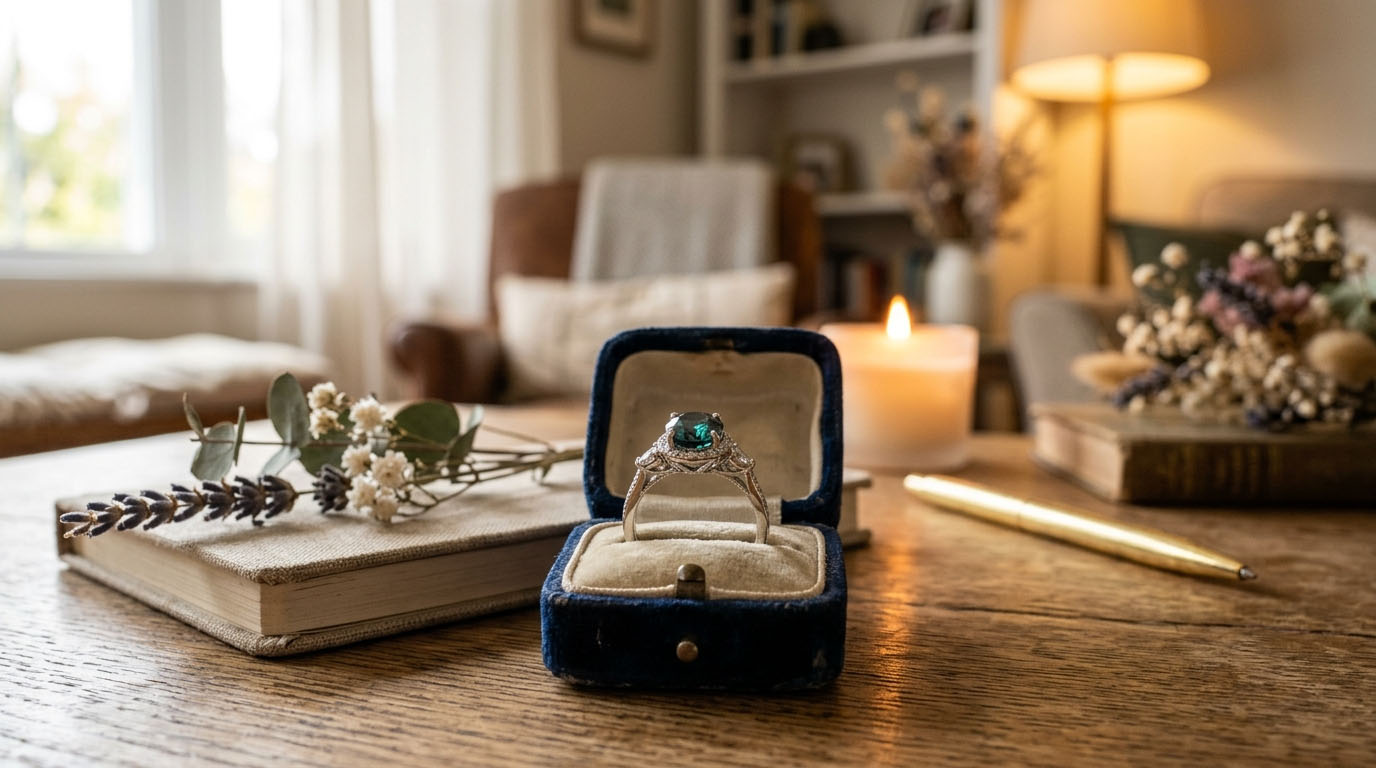
Choosing an engagement ring is rarely just about picking a beautiful stone. It’s about choosing something that will live with you through everyday routines, travel, work, celebrations, and all the quiet moments in between. That’s why more couples are starting to ask a very practical question before they fall in love with a gemstone: Is it actually suitable for daily wear?
Alexandrite often appears on shortlists for non-traditional engagement rings because it offers something most gemstones don’t: a changing personality. But beauty alone isn’t enough for a ring meant to be worn for years.
In this guide, we’ll break down whether alexandrite is truly a good choice for engagement rings—not just visually, but in terms of durability, lifestyle fit, emotional value, and long-term wear.
What Makes Alexandrite Different from Traditional Engagement Stones?
Most engagement rings are designed around consistency. Diamonds, sapphires, and moissanite are valued because they look stable and predictable under all lighting conditions. Alexandrite is the opposite. It changes. In daylight, it often appears green or teal. Under warm indoor lighting, it shifts into purple, raspberry, or reddish tones. The same ring can feel calm and understated in the morning and warm and romantic at night.
This shifting behavior is what makes alexandrite feel less like a static object and more like a living part of daily experience. Instead of one fixed identity, it carries multiple moods within a single stone.
Durability: Can Alexandrite Handle Everyday Wear?
Durability is one of the most important factors in an engagement ring. Alexandrite ranks around 8.5 on the Mohs hardness scale, which places it in the durable gemstone category suitable for regular wear.
|
Gemstone |
Hardness (Mohs Scale) |
|
Diamond |
10 |
|
Sapphire |
9 |
|
Alexandrite |
8.5 |
|
Morganite |
7.5–8 |
|
Opal |
5–6.5 |
In practical terms, this means alexandrite resists scratches from everyday contact much better than softer gemstones like opal or emerald. It is strong enough for engagement rings, especially when set in protective designs.
However, like all gemstones (including diamonds), it is not indestructible. Hard impacts or harsh conditions can still cause damage, so setting style matters.
Why Alexandrite Feels So Personal in an Engagement Ring
Many gemstones are chosen for appearance. Alexandrite is often chosen for experience. What makes it emotionally distinctive is not just that it changes color, but how it changes throughout your day.
A typical engagement ring looks the same at every moment:
- Morning commute
- Office lighting
- Dinner lighting
- Nighttime
Alexandrite creates variation in those same moments. It may appear more grounded and subtle in daylight, then shift into something warmer and more expressive at night. Over time, many wearers start associating these changes with their daily rhythm.
This creates a subtle emotional layer:
- The ring doesn’t just represent a relationship
- It reflects how a relationship naturally changes in different environments
- It feels different depending on where life takes you, while still remaining the same stone
For many couples, that idea feels more meaningful than static perfection. This is also why alexandrite has become part of a larger movement toward non-traditional engagement rings. You can explore this trend in more detail here:
Why Alexandrite Engagement Rings Are Trending: Unique Styles & Color-Changing Beauty
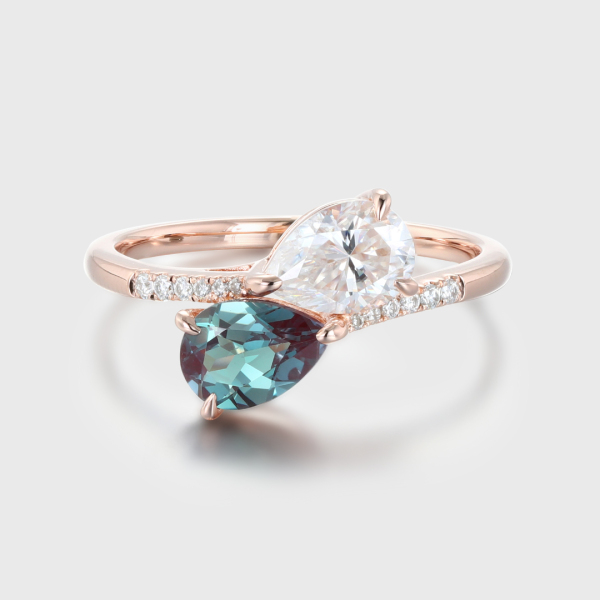
Pear Cut Toi Et Moi Engagement Ring – Lab Alexandrite & Moissanite Ring
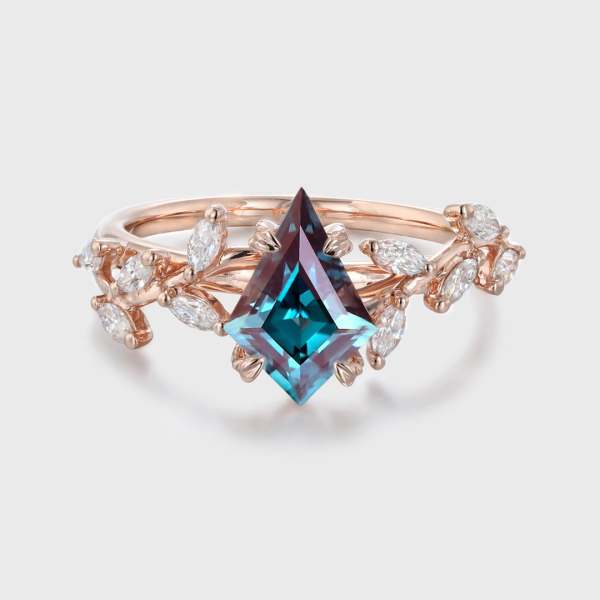
Rose Gold Nature-Inspired Kite Cut Lab-Grown Alexandrite Engagement Ring
Pros of Choosing Alexandrite for an Engagement Ring
1. Unique Visual Identity
No two alexandrites behave exactly the same under light. Even small variations in tone and transition create a ring that feels individual rather than mass-produced.
2. Excellent Everyday Durability
With a hardness of 8.5, alexandrite is strong enough for daily wear when properly set in protective designs.
3. Rare and Distinctive Without Being Flashy
Alexandrite stands out, but not in an overly bright or exaggerated way. It feels refined rather than attention-seeking.
4. Works Across Different Ring Styles
Alexandrite fits naturally into:
- Solitaire engagement rings
- Vintage-inspired settings
- Nature-inspired designs
- Halo styles
- Minimalist modern rings
5. Available in Natural and Lab Options
Lab-created alexandrite allows for more accessible pricing while maintaining the same physical and optical properties.
Potential Drawbacks You Should Know
A realistic decision always includes both sides.
1. It Does Not Look the Same All the Time
If you prefer a gemstone with a fixed, predictable appearance, alexandrite may feel less consistent than diamonds or sapphires.
Its beauty depends on lighting conditions, which means its appearance is always evolving.
2. Not as Bright as Diamond or Moissanite
Alexandrite is not designed for maximum sparkle or fire. Its appeal is color change, not brilliance.
If your priority is intense light reflection, other stones may feel more satisfying.
3. High Cost for Natural High-Quality Stones
Fine natural alexandrite can be extremely expensive, especially in larger sizes or strong color-change grades.
Lab options help reduce this barrier, but natural stones remain a premium category.
4. Requires Thoughtful Setting Design
Because color is its main feature, poor lighting exposure or overly heavy settings can reduce its visual impact.
Who Is Alexandrite a Good Fit For?
Alexandrite tends to resonate with people who want more than visual perfection.
It works especially well if you:
- Prefer meaningful or symbolic gemstones over traditional diamonds
- Like jewelry that feels slightly different throughout the day
- Want a non-traditional engagement ring that still feels elegant
- Appreciate subtle uniqueness rather than bold sparkle
- Are drawn to gemstones with personality rather than uniformity
It is particularly popular among couples choosing alternative engagement rings that reflect individuality rather than convention.
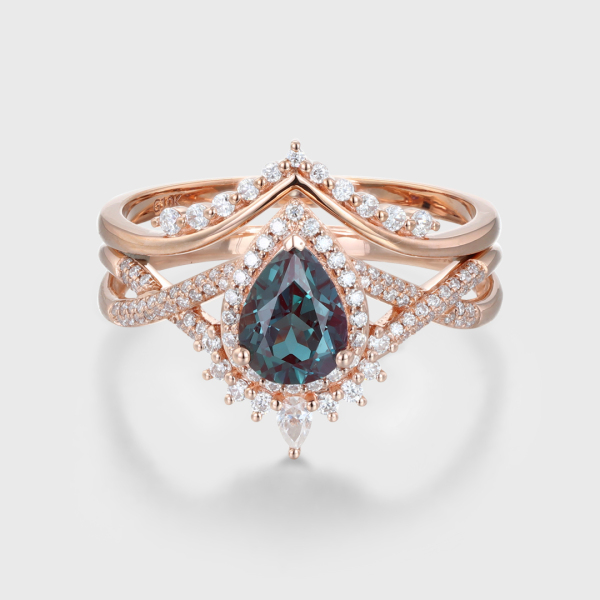
Unique Pear Cut Alexandrite Vintage Rose Gold Engagement Ring Set
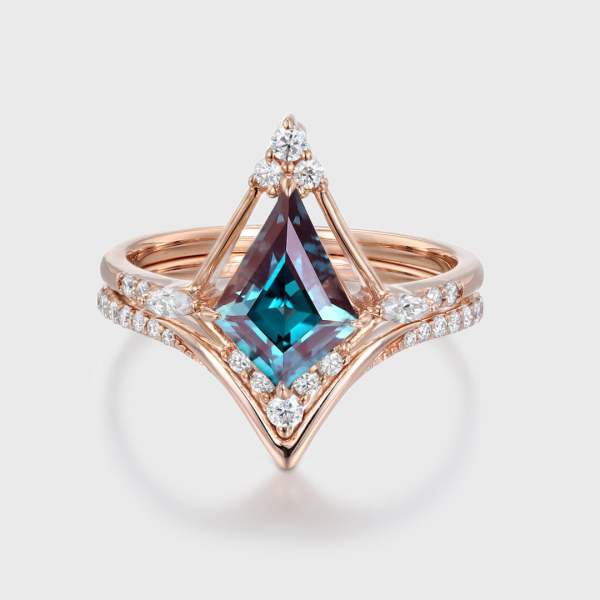
Kite Cut Lab Alexandrite Rose Gold Bridal Engagement Ring Set
Who Might Prefer a Different Gemstone?
Alexandrite may not be ideal if you:
- Want a ring that looks identical in all lighting conditions
- Prefer maximum brilliance and sparkle
- Want the most budget-friendly engagement stone
- Prefer highly predictable gemstone appearance
In those cases, diamonds, moissanite, or sapphire may feel more aligned with expectations. This isn’t a limitation of alexandrite—it simply reflects its identity as a dynamic gemstone.
Alexandrite Engagement Rings at OVEELA Jewelry
At OVEELA Jewelry, we design alexandrite engagement rings for people who value individuality in both style and meaning. Rather than treating alexandrite as a decorative accent, our designs focus on how the stone behaves in real life. We carefully balance cut, setting height, and metal tone to allow the color change to appear naturally across different lighting environments.
Many of our alexandrite rings are designed in:
- Nature-inspired silhouettes that echo organic movement
- Vintage-style settings that emphasize depth and character
- Minimalist designs that let the color shift remain the focal point
We also offer customization for couples who want to adjust proportions, select between lab and natural stones, or combine alexandrite with accent gemstones for a more personalized design. The goal is not just to create a ring that looks beautiful in photos—but one that continues to feel meaningful as it becomes part of everyday life.
Final Verdict: Is Alexandrite Good for Engagement Rings?
Yes—but not for everyone. Alexandrite is an excellent engagement ring choice if you value uniqueness, emotional depth, and a gemstone that evolves with your daily environment. Its durability is strong enough for everyday wear, and its visual character offers something few other gemstones can replicate. However, it is not the right choice if your priority is maximum sparkle, absolute consistency, or traditional diamond aesthetics.
In the end, alexandrite works best for people who don’t just want a ring that looks good—but one that feels different every time the light changes.
FAQs
Yes. With a hardness of around 8.5 on the Mohs scale, alexandrite is suitable for daily wear when set properly.
No. Its color-changing effect is a permanent optical property of the stone.
Yes. Lab-created alexandrite has the same physical and optical properties as natural alexandrite, making it a practical alternative.
High-quality natural alexandrite can be more expensive than many diamonds due to its rarity, but lab options are more affordable.
Its appearance changes with lighting, which may not suit people who prefer consistent gemstone color.