
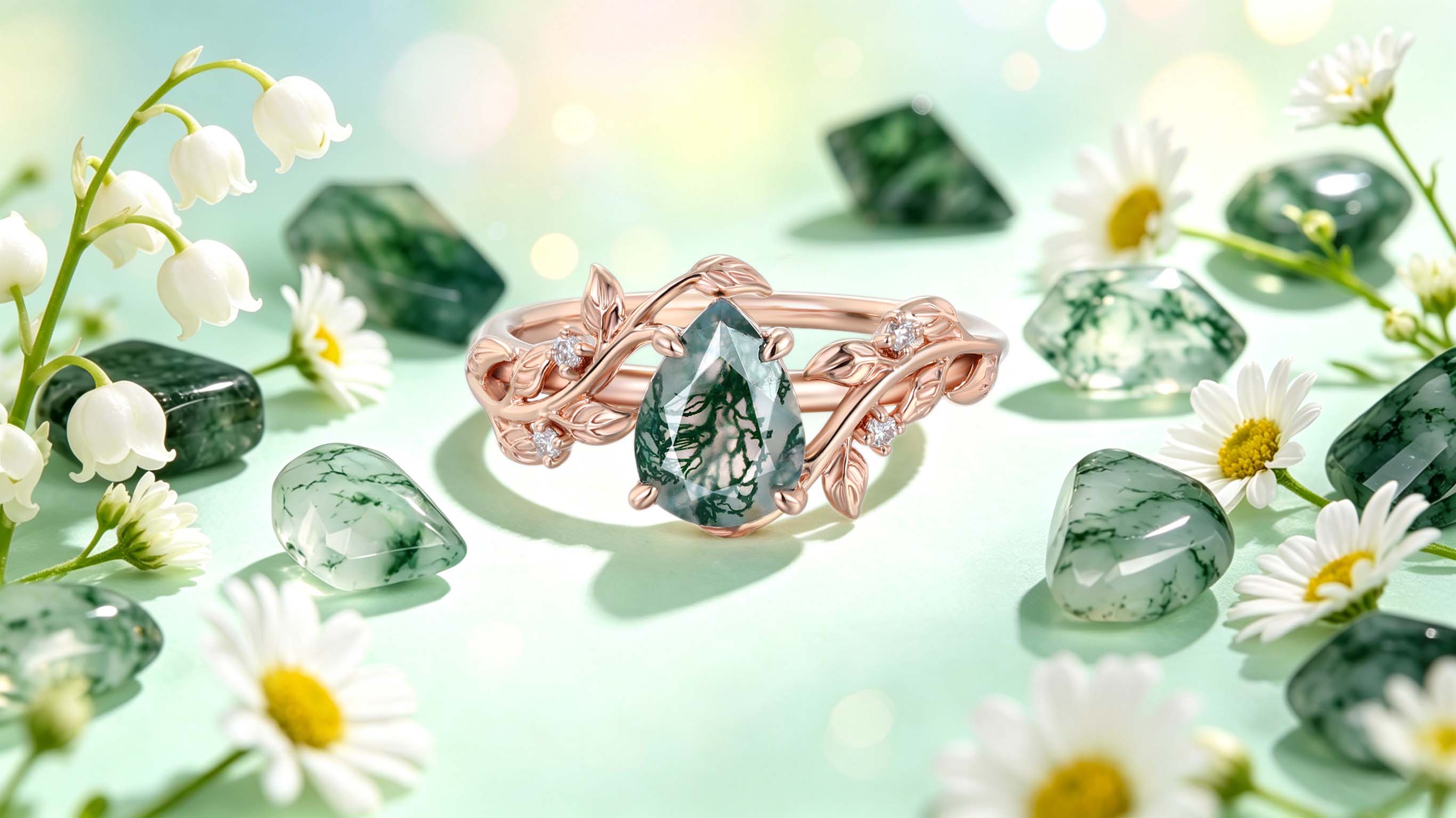
Quick Answer: Yes, moss agate is 100% natural. The moss-like patterns inside are mineral dendrites—not plants—formed underground over thousands to millions of years. Each stone is a unique geological fingerprint.
If you've ever held a moss agate ring up to the light and watched the green, branching inclusions glow like a miniature forest suspended in crystal, you've probably asked yourself: Is this even real?
In an age of lab-grown diamonds, synthetic moissanite, and dyed glass masquerading as gemstones, skepticism is healthy. But here's the truth: moss agate is one of nature's most authentic masterpieces. No laboratory can replicate the chaotic, three-dimensional depth of genuine moss agate inclusions. No factory can manufacture the story each stone carries from volcanic cavities to your jewelry box.
At Oveela Jewelry, we don't just sell moss agate jewelry—we curate pieces of Earth's history. This guide will walk you through exactly what moss agate is, how it forms, how to spot fakes, and why it might be the most meaningful gemstone you've never considered for an engagement ring.
Is Moss Agate Natural? The Complete Guide
- What Is Moss Agate? Understanding the "Not-Quite-Agate" Agate
- How Moss Agate Forms: A Million-Year Journey in 4 Steps
- Why People Question If Moss Agate Is Natural
- Is Moss Agate Ever Fake or Treated? A Buyer's Alert
- Moss Agate Meaning, Properties & Spiritual Significance
- Is Moss Agate Durable Enough for Daily Wear?
- Moss Agate vs. Tree Agate: Don't Confuse Your Greens
- Why Choose a Moss Agate Engagement Ring?
- Final Thoughts: Why Moss Agate Matters Now More Than Ever
- Frequently Asked Questions About Moss Agate
What Is Moss Agate? Understanding the "Not-Quite-Agate" Agate
Moss agate is a variety of chalcedony quartz (chemical formula: SiO₂) that contains delicate mineral inclusions resembling moss, ferns, or branching foliage. Despite its name, it is technically not a true agate because it lacks the concentric banding that defines classic agates like Blue Lace Agate or Botswana Agate.
Instead, moss agate earns its classification through what it contains, not how it's layered:
- Tree-like or moss-like dendritic inclusionsformed by iron oxide, manganese oxide, or chlorite
- Semi-translucent to translucent appearancethat allows light to pass through the stone
- Earthy color palette: deep forest greens, olive tones, rusty browns, and occasional reddish hues
- Three-dimensional depth: the "moss" appears to float at different levels within the crystal matrix
Gemology Note: The green inclusions in moss agate are dendrites—branching crystal structures that form when mineral-rich water seeps into microscopic cracks in chalcedony. These are purely inorganic formations, not fossilized plants.
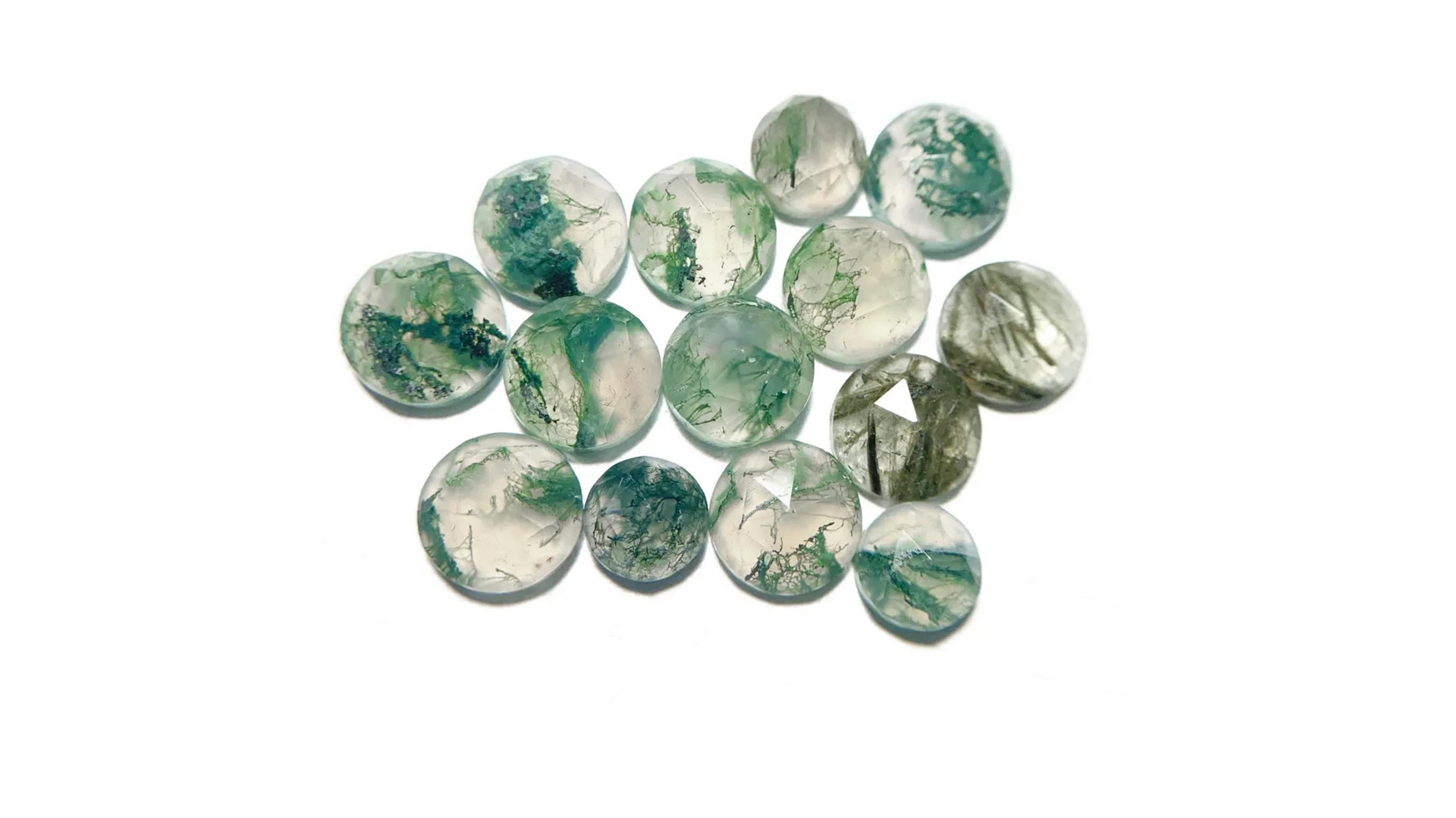
How Moss Agate Forms: A Million-Year Journey in 4 Steps
Understanding moss agate formation isn't just geology trivia—it helps you appreciate why no two stones will ever be identical.
Step 1: The Volcanic Cavity
Moss agate begins in small cavities or cracks inside cooling volcanic rock. These voids are created when gas bubbles get trapped in molten lava and solidify.
Step 2: Mineral-Rich Water Infiltration
Over millennia, groundwater carrying dissolved silica (SiO₂) and trace minerals (iron, manganese, hornblende) slowly seeps into these cavities.
Step 3: Crystallization & Dendrite Growth
As water evaporates and temperatures shift, silica precipitates into microcrystalline chalcedony. Simultaneously, metal oxides crystallize into branching dendritic patterns—the "moss" you see.
Step 4: Solidification & Preservation
The stone eventually fully solidifies, permanently preserving the dendritic inclusions in their exact formation. The result? A one-of-a-kind gemstone that can never be duplicated.
Key Insight: Because this process occurs naturally underground without human intervention, every moss agate gemstone carries a unique "fingerprint" of its specific geological conditions. A moss agate from Montana will look distinctly different from one mined in India or Brazil.
Why People Question If Moss Agate Is Natural
The confusion is understandable. Three factors fuel the skepticism:
1. The "Terrarium Effect"
When a stone looks like someone trapped a tiny forest inside glass, your brain assumes human craftsmanship. But the moss-like patterns are mineral dendrites, not vegetation. Nature is simply the greatest artist.
2. The Affordability Paradox
Moss agate costs a fraction of emeralds or diamonds. In a market where price equals perceived value, many assume "affordable" means "fake." The reality? Moss agate is abundant in deposits across India, Montana (USA), Brazil, and Uruguay. Its accessibility is a gift, not a red flag.
3. The Lab-Grown Revolution
With synthetic diamonds and moissanite dominating headlines, consumers have become hyper-aware of imitation gemstones. This awareness is good—but it shouldn't extend to naturally abundant stones like moss agate, which are rarely synthesized because the cost of lab replication exceeds the value of natural mining.
Is Moss Agate Ever Fake or Treated? A Buyer's Alert
While natural moss agate is the industry standard, imitations and treatments do exist. Here's how to protect yourself:
|
Feature |
Natural Moss Agate |
Treated / Fake Moss Agate |
|
Inclusions |
3D, irregular, chaotic patterns with depth |
Flat, surface-level, or overly symmetrical |
|
Color |
Earthy greens, browns, subtle variations |
Neon green, unnaturally uniform, or "Kool-Aid" bright |
|
Transparency |
Semi-translucent with visible depth |
Opaque or perfectly clear without depth |
|
Temperature |
Cool to the touch initially |
Room temperature (plastic) or warms quickly (glass) |
|
Bubbles |
None |
Visible round air bubbles (indicates glass) |
|
Pattern Repetition |
Never repeats exactly |
Identical across multiple stones |
Common Treatments to Watch For:
- Dyeing:Plain white chalcedony is dyed green to mimic moss agate. Look for color concentrated in cracks under magnification.
- Stabilization:Epoxy or resin infusion to improve durability. Legal but should be disclosed.
- Glass/Resin Imitations:Complete fakes with painted or molded "moss" patterns. Lack internal complexity.
Pro Tip: Always purchase from sellers who provide high-resolution photos showing inclusion depth. If every stone in their inventory looks identical, proceed with caution.
Moss Agate Meaning, Properties & Spiritual Significance
Beyond its physical beauty, moss agate carries deep symbolic weight that resonates with modern jewelry buyers.
Moss Agate Meaning: The "Stone of New Beginnings"
Historically known as the "Gardener's Stone," moss agate symbolizes:
- Growth & Renewal:The branching patterns mirror new shoots breaking through soil
- Abundance:Traditionally carried to ensure bountiful harvests—now interpreted as prosperity in all life areas
- Emotional Grounding:Connected to the Heart Chakra and Root Chakra, promoting stability during transitions
- Connection to Nature:For urban dwellers, it serves as a wearable piece of wilderness
Moss Agate Healing Properties
Crystal practitioners associate moss agate with:
- Balancing emotional energy and reducing stress
- Supporting recovery from trauma through gentle grounding
- Enhancing self-esteem and clarity in decision-making
- Encouraging patience and steady progress (rather than sudden, unsustainable change)
Modern Relevance: In 2026, moss agate engagement rings have surged in popularity among couples who see marriage not as a static milestone, but as a living, growing partnership. The stone's symbolism of gradual, organic growth aligns perfectly with this philosophy.
Is Moss Agate Durable Enough for Daily Wear?
Short answer: Yes, with proper care.
Moss agate ranks 6.5–7 on the Mohs hardness scale, making it comparable to quartz and suitable for daily-wear jewelry including engagement rings. However, it's not as hard as diamonds (10) or sapphires (9), so protective settings matter.
Best Settings for Moss Agate Rings:
- Bezel Settings:Wrap the stone's edge in metal for maximum protection
- Halo Settings:Surround with smaller stones to absorb impact
- Lower Profile:Reduces the chance of knocking the stone against hard surfaces
Daily Care Tips:
- Remove before heavy lifting, gardening, or gym workouts
- Clean with lukewarm water and mild soap—avoid ultrasonic cleaners
- Store separately from harder gemstones to prevent scratching
Moss Agate vs. Tree Agate: Don't Confuse Your Greens
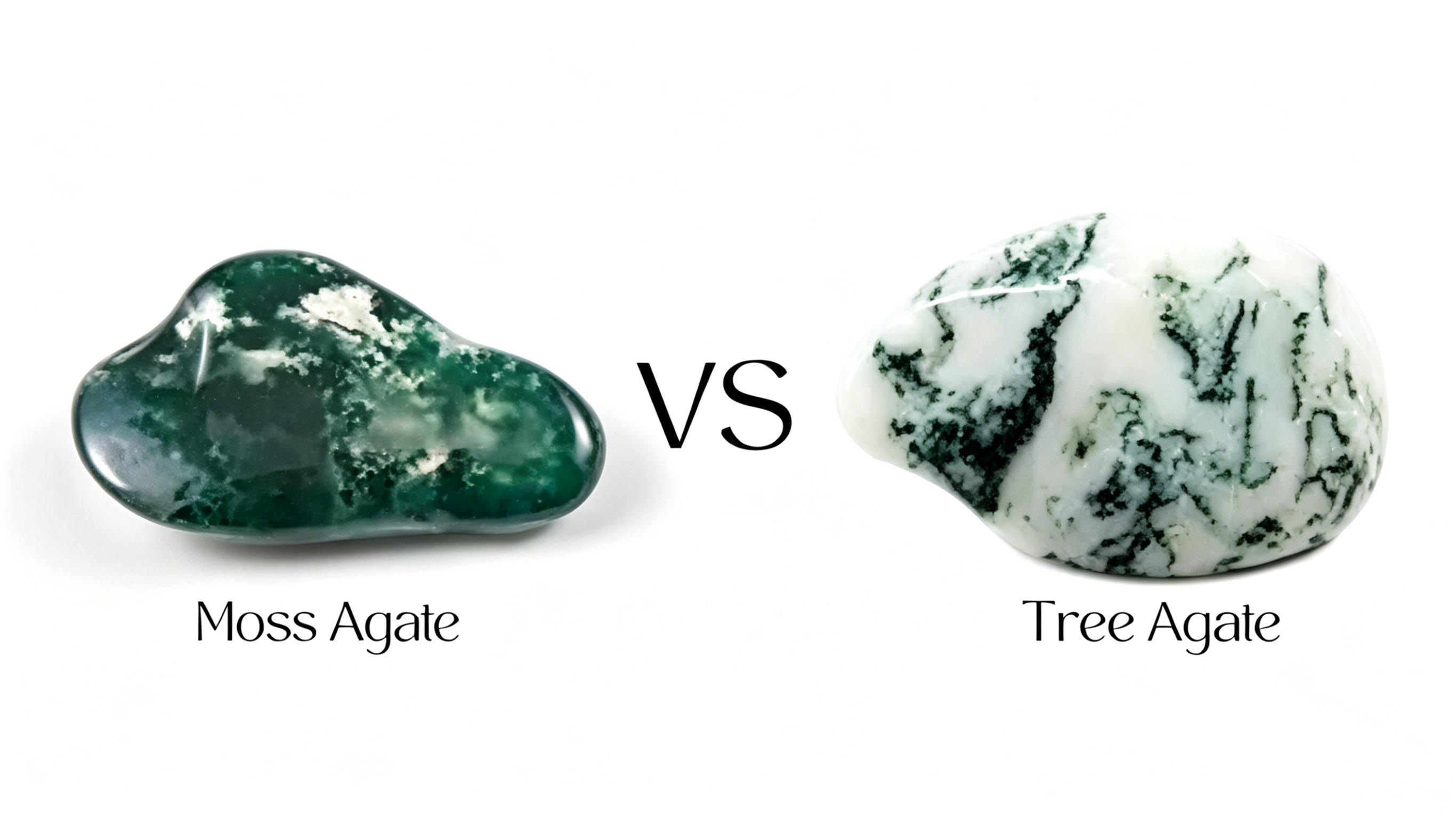
Buyers often confuse these two related stones. Here's the fastest way to tell them apart:
|
Feature |
Moss Agate |
Tree Agate |
|
Base Transparency |
Semi-translucent to translucent |
Opaque (solid white) |
|
Inclusion Appearance |
Soft, mossy, floating filaments |
Bold, branch-like dendrites |
|
Light Test |
Light passes through |
Blocks light completely |
|
Best For |
Engagement rings, pendants, glow-focused jewelry |
Statement pieces, beads, carvings |
|
Energy Vibe |
New beginnings, abundance, emotional release |
Stability, patience, deep grounding |
Remember: Both are natural chalcedony varieties. Neither is "better"—they simply serve different aesthetic and energetic purposes.
Why Choose a Moss Agate Engagement Ring?
Over the past three years, moss agate engagement rings have exploded in popularity. Three forces drive this trend:
1. Uniqueness That Diamonds Can't Touch
No two moss agates are identical. One might evoke a dense rainforest canopy; another, a misty mountain morning. For couples who reject mass-produced uniformity, this individuality is the ultimate luxury.
2. Affordability Without Compromise
A striking 2-carat moss agate center stone costs a fraction of a comparable diamond—freeing budget for custom settings, higher-quality accent stones, or experiences (like the honeymoon).
3. Symbolism With Substance
Called the "Stone of New Beginnings," moss agate carries poetic resonance for marriage. Unlike diamonds marketed through decades of advertising, moss agate's meaning is organic, ancient, and personal.
At Oveela Jewelry, every moss agate engagement ring, moss agate promise ring, and moss agate wedding band is individually examined for:
- Distinctive natural inclusions with three-dimensional depth
- Stable stone structure free of fractures
- Clear pattern visibility under natural and artificial light
- Balanced, earthy color tones (no dyeing, no enhancement)
We don't source mass-market stones. We select pieces that highlight the wild, untamed beauty that makes moss agate irreplaceable.


Final Thoughts: Why Moss Agate Matters Now More Than Ever
In a world of algorithm-generated content and mass-produced goods, moss agate stands as a defiant reminder of nature's unpredictability. It cannot be replicated. It cannot be rushed. It cannot be perfected.
Each moss agate gemstone carries millions of years of geological history—volcanic eruptions, mineral-rich waters, slow crystallization, and the patient passage of time. When you wear moss agate, you wear a story that predates human civilization.
Whether you're drawn to moss agate for its engagement ring symbolism, its connection to nature, or simply its hypnotic beauty, you're choosing authenticity over artifice. And in 2026, that might be the most rebellious choice of all.
Frequently Asked Questions About Moss Agate
Yes. Moss agate is a genuine variety of chalcedony quartz (SiO₂) with natural mineral inclusions. It is not man-made, though dyed imitations exist.
No. The "moss" is mineral dendrites—branching formations of iron oxide, manganese oxide, or chlorite. They resemble vegetation but are purely inorganic.
Look for irregular, three-dimensional inclusions with depth. Real moss agate feels cool to the touch, lacks air bubbles, and never has perfectly repeating patterns. When in doubt, consult a certified gemologist.
Yes, with caveats. At 6.5–7 Mohs hardness, it's durable enough for daily wear when set in a protective bezel or halo. It's ideal for couples prioritizing uniqueness and symbolism over tradition.
Major deposits are found in India, Montana (USA), Brazil, Uruguay, and central Europe. Montana moss agate is particularly prized for its red and black inclusions on translucent backgrounds.
Yes. With a Mohs hardness of 6.5–7, moss agate can safely contact water. However, avoid prolonged exposure to harsh chemicals, steam cleaners, or ultrasonic jewelry cleaners.
Moss agate is semi-translucent with soft, floating green inclusions. Tree agate is opaque white with bold, branch-like dendrites. Both are natural chalcedony but serve different aesthetic purposes.
Crystal traditions associate moss agate with the Heart Chakra and Root Chakra, linking it to emotional balance, new beginnings, abundance, and connection to nature. These properties are spiritual beliefs, not medical claims.
Prolonged direct sunlight can cause slight fading over time. Store moss agate jewelry in a fabric-lined box away from windows when not worn.
No. Moss agate is relatively affordable due to abundant natural deposits. Prices vary based on pattern quality, transparency, cut, and origin—but it remains accessible compared to diamonds, emeralds, or sapphires.